Its still a rough idea that may be subject to some tweaking, as I'm still trying to gather more research material.
Showing posts with label Essay. Show all posts
Essay Idea: Hayao Miyazaki
Posted by
Leo Tsang
on
Monday, March 22, 2010
As of yet, my initial idea involves exploring Japanese animation through Hayao Miyazaki in his philosophy and techniques that contrasts the Disneyan principles of animation. I will most likely take a specific example of his films to analyse more thoroughly.

Its still a rough idea that may be subject to some tweaking, as I'm still trying to gather more research material.
Leave a comment:
2
comments
Labels:
Essay,
Hayao Miyazaki,
Year 1: Unit 5
Essay Idea: Gladiator
Posted by
Leo Tsang
on
Wednesday, February 10, 2010
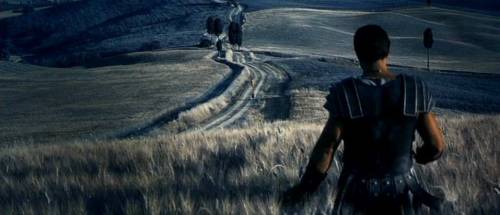
Looking at a number of films to serve as the basis for my essay, I've more or less begun to settle on the film Gladiator. Directed by Ridley Scott in 2000, Gladiator is a universally acclaimed film winning a number of awards including the BAFTA award for Best Editing, headed by Pietro Scalia. The composition of shots from the opening scene of the hand over wheat fields immediately gives us an understanding to Russell Crowe's character, to placing us right in the centre of a gladiatorial arena for some gripping and tension filled action.


I also intend to re-storyboard a small clip from the same film to further examine the choice in cinematography, as well as fulfil the 'film clip' storyboard sequence of the brief.
Leave a comment:
0
comments
Labels:
Essay,
Gladiator,
Year 1: Unit 4
Essay - Uncanny
Posted by
Leo Tsang
on
Friday, January 22, 2010
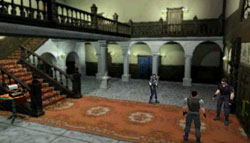
Been meaning to post this a while ago, but I eventually wrote my essay on the uncanny nature in the original classic 'Resident Evil' game made in 1996. A survival horror game produced by the developers ‘Capcom’, it became one of the first games to fully capture horror and tension in a video game.

There's an array of uncanny elements with the most notable being the third person fixed camera position, creating a range interesting effects that similarly added to the horror and tension of a claustrophobic camera, and restrictive controls.

I played the game during my childhood which I remember being pretty scared at the time (as well as some awful dialogue lines due to its poor transition in translation). Due to the style and nature of the game, it still retains much of the same drama and tension even to this day, proving its position as a timeless classic.
There's an array of uncanny elements with the most notable being the third person fixed camera position, creating a range interesting effects that similarly added to the horror and tension of a claustrophobic camera, and restrictive controls.
I played the game during my childhood which I remember being pretty scared at the time (as well as some awful dialogue lines due to its poor transition in translation). Due to the style and nature of the game, it still retains much of the same drama and tension even to this day, proving its position as a timeless classic.
Leave a comment:
0
comments
Labels:
Essay,
Year 1: Unit 3
Essay Update
Posted by
Leo Tsang
on
Wednesday, November 25, 2009
Finished my essay a few days ago, thought I make a quick post about it. My essay explores the production design of Valve's 'Team Fortress 2', a classed based multilayer game released in 2007 as part of the Orange Box package. Since the games' release, there's been a total of 97 updates for the game, 97! That's roughly one update per week - talk about supporting your product.

As mentioned before, the visual style changed dramatically throughout development, later favouring a cartoon 50s - 60s industrial look with key design and gameplay issues in mind, such as the need to quickly identify character classes from each other. Thus, some areas I looked at was their inspiration for the art style such as rim highlighting, character design lead by silhouettes and impressionistic environments.
I'm a little up on the word count, which I hope is fine. Other than that, I quite enjoyed writing the essay learning the way in which Valve approach their games in production design.
Leave a comment:
0
comments
Labels:
Essay,
Team Fortress 2,
Year 1: Unit 2
Essay Ideas
Posted by
Leo Tsang
on
Sunday, November 08, 2009
With out written assignment exploring the creative process design behind one film/computer game, I've had a number of ideas with films such as Pixar's 'Wall-E' as well as the wide range games all with their own unique creative and design challenges. A prime example is Bioware's immense world of 'Mass Effect', where their creative process was led entirely by constructing a history, lore and narrative of an entire galaxy, explaining each and every detail of the nature of new worlds to the mechanics of every vehicle. The lengths of which they've gone to is remarkable with an entirely dedicated codex built into the game.
Ultimately, I'm settling on the idea of basing my essay on Valve's 'Team Fortress 2', a multiplayer first person shooter with a very distinct art style. Undergoing 10 years of design and production before finally releasing in October 2007, the game's visual style has changed dramatically over development.
Early Development

Final Result

The core design philosophy of Valve is very inspiring going into great depths with their design and aesthetic choices. To this day, Valve has continued to support Team Fortress 2 with substantial updates that radically change the state of play, as well as producing a number of film shorts in bringing life and character to the game.
Valve fortunately keep a blog exploring some of their creative processes that are very insightful. You can find it here at http://www.teamfortress.com/.
Any thoughts are most welcome.
Leave a comment:
0
comments
Labels:
Essay,
Team Fortress 2,
Year 1: Unit 2
Arnold Newman + Essay Development
Posted by
Leo Tsang
on
Sunday, October 11, 2009
I've been refining my essay idea looking through a number of resources. The book 'Interviews with Master Photographers' has provided a fantastic insight into the techniques and philosophies of photographers, particularly with portraiture photographers Yousuf Karsh and Arnold Newman.
Newman interested me in particular with his ideas that photography is not confined to realism, but gains a 'new power when it is released from realism'. To the contrary to popular belief, Newman finds 'many things false in photography' but rather an illusion of reality that we must recognise and interpret like any other art form.
Newman produced a particularly powerful piece of Alfried Krupp, a 'horrible human' who chained his slaves to machinery of his arms factory to stop them from escaping when the bombers came. He underfed his workers 'even to Nazi standards', sending them to concentration camps once they underperformed. Newman himself states that the subject makes the piece, suggesting that he has simply portrayed the Krupp for who he is, essentially as 'the face of evil'.

A powerful portrait, if a little contrived, reminiscent to the power a portrait can have with the previous example of Myra Hindley.
---
Being well aware of the vastness of my initial essay title, I have begun to narrow this down adjusting the focus to look at an area of transition in photographic portraiture. Thus, I am considering the title of: 'A Transition of Photography in Portraiture and the Nature of Identity', which hopefully narrows down the subject area of focus.
The structure would consist:
Thoughts and feedback are welcome.
Newman interested me in particular with his ideas that photography is not confined to realism, but gains a 'new power when it is released from realism'. To the contrary to popular belief, Newman finds 'many things false in photography' but rather an illusion of reality that we must recognise and interpret like any other art form.
Newman produced a particularly powerful piece of Alfried Krupp, a 'horrible human' who chained his slaves to machinery of his arms factory to stop them from escaping when the bombers came. He underfed his workers 'even to Nazi standards', sending them to concentration camps once they underperformed. Newman himself states that the subject makes the piece, suggesting that he has simply portrayed the Krupp for who he is, essentially as 'the face of evil'.

A powerful portrait, if a little contrived, reminiscent to the power a portrait can have with the previous example of Myra Hindley.
---
Being well aware of the vastness of my initial essay title, I have begun to narrow this down adjusting the focus to look at an area of transition in photographic portraiture. Thus, I am considering the title of: 'A Transition of Photography in Portraiture and the Nature of Identity', which hopefully narrows down the subject area of focus.
The structure would consist:
- Small introduction of photographic portraiture
- Photography's attempt to capture identity of the soul and essence of the subject
- Conversely following photography's obliteration of identity
- Conclusion
Thoughts and feedback are welcome.
Leave a comment:
0
comments
Labels:
Arnold Newman,
Artist,
Essay,
Photography,
Year 1: Unit 1
Essay Ideas
Posted by
Leo Tsang
on
Sunday, October 04, 2009
A number of ideas have been running through my mind concerning the essay. One idea is to look at the impact of photography in portraiture with the additional significance it has had on concepts of identity. A number of resources I could look are at artists such as Yousuf Karsh, Cindy Sherman and Sam Taylor Wood, as well as further exploring the effects of photo manipulation techniques. The title could be:
Alternatively, I could draw a more equal comparison to painted and photographic portraiture, following the transition portraiture and the nature of identity has undertaken. This would include some further artists such as Rembrandt, Albrecht Dürer and Frank Auerbach. The title may be phrased as something like:
Well, these are the two stronger ideas I have had for the essay. Some thoughts and feedback will be greatly appreciated.
The Impact of Photography on Portraiture and the Concept of Identity
Alternatively, I could draw a more equal comparison to painted and photographic portraiture, following the transition portraiture and the nature of identity has undertaken. This would include some further artists such as Rembrandt, Albrecht Dürer and Frank Auerbach. The title may be phrased as something like:
The Transition of Portraiture through Painting and Photography
Well, these are the two stronger ideas I have had for the essay. Some thoughts and feedback will be greatly appreciated.
Leave a comment:
0
comments
Labels:
Essay,
Year 1: Unit 1
Subscribe to:
Posts (Atom)