With the head of the Games Model completed, we have moved on to create the body of the character following the same principles as before, where the model is not smoothed relying on the softening/hardening of normals. Additional faces are also given to areas of particular deformation.
With the world of my animation revolving around a junkyard, it makes natural sense that the design and aesthetic should similarly be inspired by junk. Thus, as suggested by tutor Alan, I have taken a range of reference images of junk and cutout individual parts/objects for a range of intriguing forms and shapes.
I've then combined the forms together to create silhouette designs of the possible type of characters in the animation.
This approach has produced some intriguing designs which is leading me to consider the possibility of having the characters be made entirely of objects of junk, rather than be human in form and figure. Where their construction would also affect their performance in the way they move.
More experiments with Maya dynamics using Curve Emitters and Curve Flow to create a shockwave, fireworks, a particle trail following a motion path as well as intersecting surfaces to create a shore effect around an island. Even with these fairly straightforward effects, one can begin to see the potential of dynamics for further uses.
We have continued modelling the game model head adding the final details such as the ear and hair. With a low poly model, much of the detail will come from texturing and normal maps.
Some quick thumbnails envisioning the type of shots possible for my animated short. Namely, the figures will perform around a central idol made similarly from the junk, where there will be a main figure performing the majority of movements.
With a concentrated character performance, the designs of my characters will have to work on a number of levels from visual appeal to practicality when animating. First however, I have experimented with a range of character shapes and proportions forming various silhouette designs.
The main feature in the designs is the mask which can be varied to give the illusion of several characters.
The designs with extraggerated proportions are notably working better, particularly the 2nd of 3rd designs of page 1, as well as the designs on the third page.
To help mix things up in my concepts, I have approached these designs differently using the software Alchemy - a drawing application designed to be widely experimental in nature. These tribe mask designs were made using loose abtract forms and shapes combined with the use of the mirror function.
I had some fun with these as I let go of concerns such as detail or line. While these are not final, they serve as initial musings that may have potential to be explored and developed further.
If you're interested in using Alchemy, you can download it here - its free and there's no need for installation as it runs independently.
My main concept is that the dehumanised population dancing to a ritual have also returned to the fashion of masks, made from various scraps and materials. Not only does this provide some interesting designs, but can also help economise my efforts as several masks can be modelled/textured differently to give the illusion of several different characters. As such, I've been gathering some visual reference material in the form of tribal masks for inspiration.
I've been researching the type of movements for my character performance short. Mainly, I've been looking at tribe dances for inspiration as it resembles the original sound piece with ceremonial type movements. Here are some examples:
Props such as poles or instruments can be another interesting feature to consider when animating my piece.
Storyboarding and animatics will become integral for me in planning my character movements - which I hope to get up soon enough.
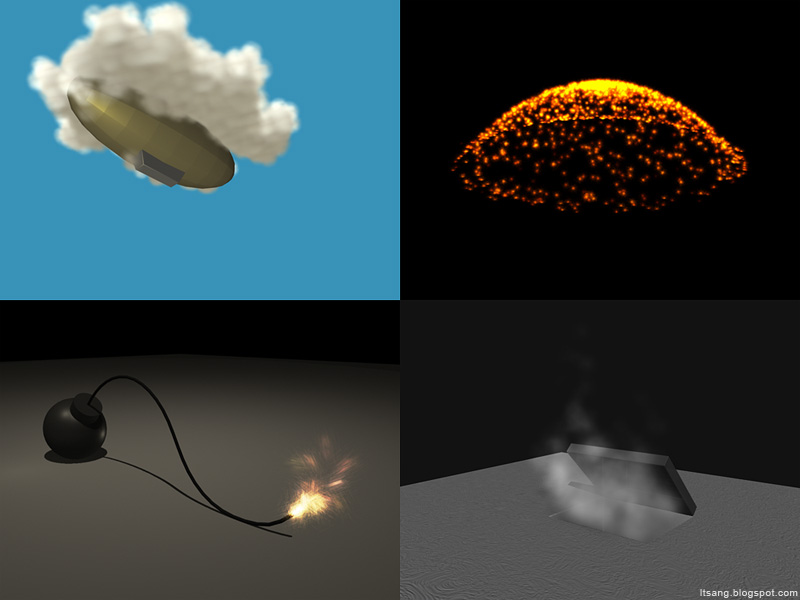
For this set of Maya tutorials, we're beginning to look at dynamics with particles and emitters. Here are a few tests experimenting with the various use of emitters and particles to create a number of effects; from clouds, fuse, an explosion and steam.
Modelling for games can often impose a budget to the amount of faces/polygons one can use at their disposable. The polygon model will not be smoothed, allowing for the use of triangles in the geometry to maximise efficiency. Additionally, softening/hardening the edge of normals are used to complete the model.
Here, we have begun to model a head with the above principles of game modelling in mind.
The transition project is a prime opportunity to experiment and explore specific areas of the pipeline further before the start of the third and final year. As such, it came to my attention that the act of animating itself is an area I have not had much time to fully explore or develop on, often becoming the last area of focus. Thus, I aim to use this project to concentrate on the process of animation, leaving areas such as environments as a lesser concern in order to maximise my time animating.
My revised idea for this project is to transcribe the original sound piece from the earlier summer project 'Soundscape 17', creating a concentrated character performance animated short. As the track is a lengthy 5 minutes, I will most likely take a segment of the track to animate to.
The performance I have in mind is a ritual type dance matching the tone and rhythm of the track. Where there will be a central figure of focus, perhaps there is also an opportunity to have some extras with repeated movements in the background. The context of my designs will stem from my original idea I had from the soundtrack; with an apocalyptic world consisting of a dehumanised population reduced to a tribe like community, where various junk and technology are used as masks or idols. In my mind, the ritual dance takes place in a junk yard around a central totem made from the scrap, though I would form the environment with a minimalistic approach if I do decide to include an environment for the space the figure(s) to move in, so as to focus on the animation itself.
I feel there are several ways I can approach this, where most of the answers will come once I begin to design the various elements.