Ladislaw (or Ladislas) Starewicz's The Mascot is a fantastic piece of 3d stop animation film. Made in 1933, the achievement is incredible with the notable attention to detail to movement and aesthetics, as well as the rear screen projection immersing the animation into a real world environment. Little, if any wires are seen at all proving its technical merit.
The Mascot (1933) by Ladislaw/Ladislas Starewicz
Perhaps what struck me most was in the humour and personality that Starewicz was able to create in his characters, being genuinely charming and funny at times with a great sense of sensitivity. It was certainly ahead of its time.
Refrigerator Concepts #01
Some sketches exploring the ways to bring my object of the refrigerator alive.
The 1950s aesthetic certainly brings some charm to the refrigerator, while I've also experimented in bringing some life into the character with some reactions. Although, I am slightly concerned whether this design feels a little too cute for a cantankerous character. The little character found in some of the sketches is a story element I'm considering for the main object of the refrigerator to play off with.

While exploring some different shapes and designs, another interpretation involves subtly suggesting a face with the arrangement of drawers and handles. Additionally, with the story component of cantankerous, perhaps a square and more menacing demeanour would work well in capturing the element of the cantankerous, despite it feeling a little less aesthetically appealing.


Thoughts and feedback welcome.
Leave a comment:
2
comments

Walk Cycle #01
Here is my first attempt at a standard walk cycle animation (with none other than Felix Junior). It wasn't as complicated as I first thought, although there are some tricky areas especially when attempting to achieve more accurate results. Alas, despite my best efforts, there still seems to be a notable sliding in the walk cycle when moving forward. Though with more practice and experience I'm sure I'll be able to rectify this in future.
Leave a comment:
0
comments
Rigging - Legs
First workshop into rigging starting with a pair of legs.


Leave a comment:
0
comments
Short Animations With Refrigerators
Some visual research into existing animations containing refrigerators.
ふりっじす Fridges (Short Animation Movie)
A tale of abandoned fridges with some cute animations - though I think I'll avoid the hands and feet as it removes the challenge of bringing an object alive with character.
Mr Bean - Fly in the fridge
A classic clip from Mr Bean involving a scene with a fridge.
While these have great little stories, I intend to focus predominately on the object itself so as to not get bogged down with an overly complicated story arc and background elements. Although, the addition of a character or environment could be a good opportunity for the main object of the refrigerator to interact with.
Leave a comment:
0
comments
Refrigerator/Fridge References
Looking at some visual imagery for the refrigerator/fridge object. With the arrangement of drawers and handles, I thought this could resemble a face in a subtle way, while flapping doors and opening drawers could further give character to the refrigerator.


While the above fridges being rather generic modern examples, I think a more iconic stylised aesthetic would work much better in terms of general appeal and character.
1950s Big Chill style fridge


The iconic Smeg fridges


However, with the fridge being a cantankerous fridge, perhaps a more rustic aesthetic would fit this more with old and retired tone that is inevitable stubborn.


Leave a comment:
1 comments
Walt Disney 1901 - 1966
Steamboat Willie (1928)
The first original Disney animation to be produced. It was particularly renown to be the first animation to successful synchronise sound within the animation.
Fantasia (1940)
Disney's Fantasia featured visual animation as an interpretation to classical music, establishing much of the whimsical fantasy that Disney is often associated with. Such as the scene of the dancing mushrooms, bringing inanimate objects to life full of charm and character. It was also featured in full colour.
Night on Bald Mountain Part 1 (1940)
Features a fantastic interpretation of evil, set in a little village at the foot of a mountain.
The art for this quite amazing being particularly dark and unsettling that is often not recognised of Disney.


Mickey The Sorcerer's Apprentice (1940)
Perhaps most renown of Disney's Fantasia, is Mickey as the Sorcerer's Apprentice. The style of animation in full colour with squash and stretch, anticipation and timing is most iconic of Disney, as Mickey is most recognisable as he is today capturing most of his characteristics.
Leave a comment:
3
comments
Norman Mclaren 1914 - 1987
Canadian animator Norman Mclaren 1914 - 1987, is a great example of early experimental types of animation.
Lines Horizontals (1962)
Mclaren creates the illusion of movement and speed quite spectacularly with the mere use of horizontal lines.
Le Merle (The Blackbird) 1958
A funny surreal cartoon style animation by Norman McLaren and Evelyn Lambert, in response to a Canadian verse.
Pas de deux (1968)
As two ballet dancers perform, Mclaren adds surreal multi and after-image layering effect for a truly wonderful unique visual effect. Individually, they celebrate the beauty of the human form with strong repeated poses, only to further create interesting abstract forms and movements and these layers begin to overlap.
An extract from 'Canon', here is a another example of Mclauren and his multi, after-image effect with a comical spin - 1964.
Leave a comment:
0
comments
Winsor McCay 1867 - 1934
Winsor McCay, an early pioneer of animation techniques, is best known for his animations Little Nemo and Gertie the Dinosaur. Both feature some of the very first examples where hand drawn animation came to life on the big screen to the wonder and amusement of all.
These first animations feature bringing a character to life with movement and intention, while Gertie the Dinosaur develops this further injecting personality into the character.
Little Nemo (1911)
Gertie the Dinosaur (1914)
It is truly remarkable to think how these are some of the first pioneering techniques in hand drawn animation, that still exists to this today. Produced by McCay himself, he became one the first leading examples to demonstrate the power and capabilities of animation.
Sinking of the Lusitania (1918)
I found McCay's Sinking of the Lusitania to be quite exceptional. Made in response to the unprovoked German attack of the liner, McCay developed his earlier techniques to a more serious direction, with the use of line and tone that creates a wonderful aesthetic quality to the animation in the smoke and dripping water of the ship. Smooth almost silk like, its beautiful yet touching as the animation is allowed to rest and settle on the tragic sinking of the liner.
Leave a comment:
0
comments
Eadweard Muybridge 1830 - 1904
In the founding principles of animation, one cannot forget Eadweard Muybridge, a photographer who is the great founder and pioneer of the moving image that is now known as animation today.
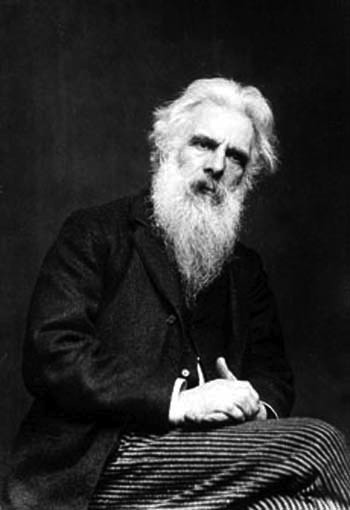
Using multiple cameras, Muybridge essentially discovered and defined the amount of images that needed to be shown every second in order to create the illusion of movement, founding what we know today as the amount of frames per second.
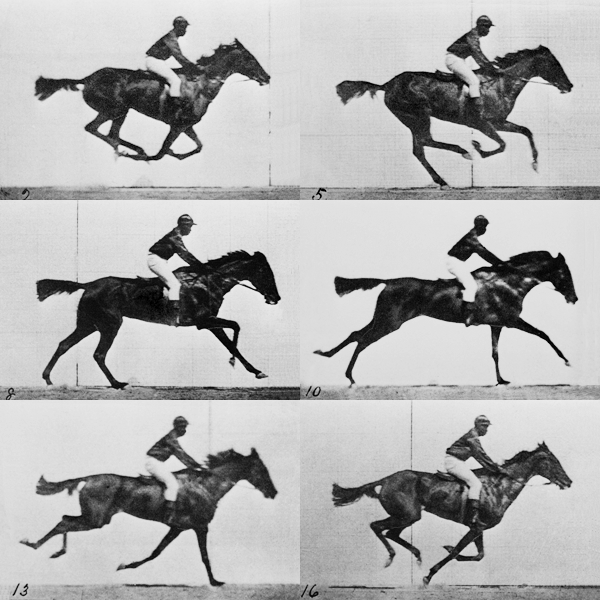

As images are shown in quick secession in a format of 24-25 frames per second, we are able to retain the previous image in our mind to enable us to see the illusion of movement. By examining these individual frames, Muybridge essentially discovered that the running cycle of a horse left the ground on all four hooves for a brief moment in time.
Thus, this is the founding principle of all animation, relying on the perceptual phenomenon that is the persistence of vision to create the illusion of movement. It is an amazing power to behold, effectively having the ability to create new worlds in that of the moving image.
Perhaps a fitting example of this is in the flipbook style animation of Ian Mackinnon and his short film Adjustment. Each individual image is lovingly drawn for a truly incredible effect in the midst of a story of a failing relationship.
Using multiple cameras, Muybridge essentially discovered and defined the amount of images that needed to be shown every second in order to create the illusion of movement, founding what we know today as the amount of frames per second.

As images are shown in quick secession in a format of 24-25 frames per second, we are able to retain the previous image in our mind to enable us to see the illusion of movement. By examining these individual frames, Muybridge essentially discovered that the running cycle of a horse left the ground on all four hooves for a brief moment in time.
Thus, this is the founding principle of all animation, relying on the perceptual phenomenon that is the persistence of vision to create the illusion of movement. It is an amazing power to behold, effectively having the ability to create new worlds in that of the moving image.
Perhaps a fitting example of this is in the flipbook style animation of Ian Mackinnon and his short film Adjustment. Each individual image is lovingly drawn for a truly incredible effect in the midst of a story of a failing relationship.
Leave a comment:
0
comments
Suzie Kent Lecture + Workshop
Today we had the company of visiting lecturer Suzie Kent, an animator with an illustration background. It was great hearing an illustrator's perspective and experience into animation, giving an insight into her own individual creative journey, as well as key ideals involving submissive and harmonious environments within animation to suit the narrative.
I remembered seeing the Tale of How by the Black Heart Gang a while back at Short & Sweet, an animation full of wonderful visuals accompanied by what I found to be a captivating opera narrative. I felt it communicated the plot suitable enough, as a quirky tale of one that answers the call to save their kind from the beast in a trojan horse type fashion.
In the workshop, we were tasked in creating an environment that fit a specified theme given in the brief. After some quick thumbnails, I eventually settled on the theme of Manic.


I think I focused compositionally first, rather than on specific individual content. The erratic harshness of lines alluding to a stalagmite cave environment, reflect a manic atmosphere to the piece with dark creatures lurking within.
Leave a comment:
2
comments
Life Drawing #7
Life drawing returns! After the hiatus I felt a bit rusty at first but things soon picked up. Its great getting back into the thick of things.


Leave a comment:
0
comments
Subscribe to:
Posts (Atom)


